Chat with us

Outsourced Mortgage Processing: How It Works From Application to Clear to Close
Most brokers who look into outsourced mortgage processing ask the same thing first: "What actually happens to my file after I send it?" It's a fair question. You're handing a borrower's loan, and your reputation with that borrower, to a team you don't sit next to.
The good news is that outsourced processing isn't a black box. It follows the same path a file takes with an in-house processor. The difference is who handles each step and how many specialists are behind it.
This guide walks through outsourced mortgage processing from application to clear to close. It covers what you do, what your processor does, and where the hand-offs happen.
Quick answer: Outsourced mortgage processing means a licensed third-party team handles the work between a loan application and clear to close. That includes file setup, disclosures, document collection, ordering third-party services, underwriting submission, and clearing conditions. The loan officer keeps the borrower relationship and the loan decisions, and usually pays per file instead of carrying a processor’s salary. With Willow Processing, the support doesn’t stop at clear to close. A dedicated setup team gets every file ready from day one, and a post-closing team handles trailing documents and investor items after funding. You get one team for the whole loan, from setup through post-close.
What Is Outsourced Mortgage Processing?
Outsourced mortgage processing (also called contract mortgage processing or third-party loan processing) is when a mortgage broker or loan officer hires an outside, licensed processing company to prepare loan files for underwriting and closing. The processor works inside your workflow and your loan origination system (LOS). It works under your brand, and the borrower still sees you as their lender contact.
Here's how responsibilities usually split:
| Stage | Loan officer / broker | Outsourced processing team |
|---|---|---|
| Application | Takes the application, prices the loan, picks the lender | Receives the file |
| Registration & disclosing | Approves the loan terms | Setup team registers the loan and sends initial disclosures |
| Open title | Shares the contract and title company details | Processor opens the title order |
| UW submission | Stays the borrower's main contact | Processor collects and reviews documents, then submits the file |
| HOI, title & order outs | Approves costs when needed | Processor orders insurance, title work and other third-party items |
| Clearing conditions | Handles pricing changes and borrower questions | Processor sorts and clears conditions, then resubmits |
The point of outsourcing is that loan officers spend their time selling and advising borrowers instead of chasing documents.
How Outsourced Mortgage Processing Works: 7 Steps From Application to Clear to Close
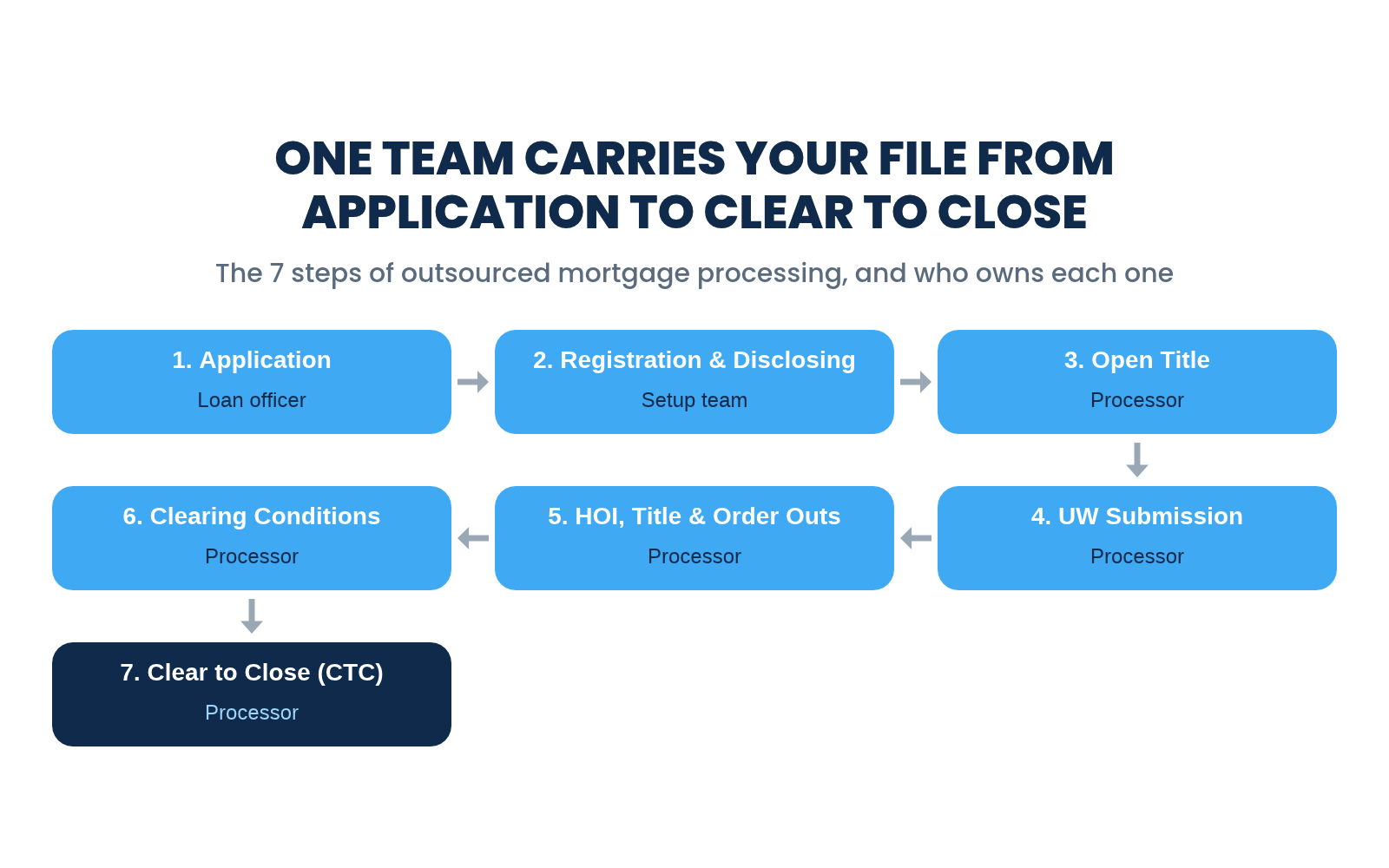
After the application, the loan officer hands off the file and steps back in only for pricing, borrower questions, and final numbers.
Step 1: The loan officer takes the application
It starts with you. You take the application (the 1003), pull credit, structure and price the loan, and choose the lender. Then you send the file to your processing team, with notes on anything unusual, such as a self-employed borrower, a gift, or a tight closing date. Clear notes here save days later.
Step 2: Registration and disclosing
The setup team registers the loan with the lender and gets the file ready to move. They confirm the borrower's information in your LOS, check that the loan program and lender match, and set up the file's checklist and contacts. Then they prepare and send the initial disclosures. Federal TRID rules require the Loan Estimate to go out within three business days of the application, so a dedicated team that handles setup and disclosing quickly keeps the file on schedule from day one.
Step 3: Opening title
Once the file is set up, the processor opens title. They place the order with the title company, share the contract and borrower details, and confirm the contacts on both sides. Opening title early gives the title company time to run its search and catch liens, vesting issues, or other problems before they hold up closing.
Step 4: Underwriting submission
Next, the processor builds the file for underwriting. They collect the documents the loan needs, such as pay stubs, W-2s or tax returns, bank statements, and explanations for anything that stands out. They review everything the way an underwriter would, calculating income and checking assets for large deposits. Then they package the file with a clear cover letter and submit it. The cleaner the package, the shorter the condition list that comes back.
Step 5: HOI, title, and third-party order outs
While the file is in underwriting, the processor orders everything else the loan needs from outside vendors. That includes the homeowners insurance (HOI) policy, the title commitment and title work, and third-party items such as verifications of employment and flood certification. They track each order and follow up when one stalls. A late insurance binder or title report is one of the most common reasons closings slip.
Step 6: Clearing conditions
Almost every loan comes back "approved with conditions" (items the underwriter needs before final sign-off). The processor sorts the conditions into what the borrower must provide, what third parties must provide, and what the processor can clear directly. Then they work through the list and resubmit. You only step in when a condition changes pricing or needs a conversation with the borrower.
Step 7: Clear to close
When the last condition is signed off, the lender issues the clear to close (CTC). The processor coordinates the Closing Disclosure, which the borrower must receive at least three business days before closing. They also confirm final figures with title and escrow and help schedule the signing.
How You Stay in the Loop: Communication, Technology and Timelines
The most common worry about outsourced mortgage processing is losing visibility. A good provider avoids that in three ways.
 One point of contact. You work with a dedicated processor who knows your files, your lenders, and how you like to work. Setup, disclosures, and post-closing specialists support them behind the scenes.
- Work happens in your LOS. Your processor logs in to the same loan origination system you already use, such as Arive or LendingPad. Notes, conditions, and documents stay in one place, and nothing lives in a separate system you can't see.
- Status you can check anytime. File status portals and regular updates mean you don't have to send "where are we on this?" emails.
How long does outsourced processing take? It runs on the same timeline as your loan, because the processor works the file from the day you submit it until it closes. What changes is how much of that time is spent waiting. Specialists handle setup and disclosures the same day, and documents and third-party orders run at the same time instead of one after another. Most delays come from slow documents, appraisals, and title, not from the processor. Our blog on common delays in the mortgage timeline covers how to avoid them.
Compliance goes with the file. An outsourced processor handles borrower data and must protect it under the GLBA. Processors also need the right state licensing. For details, see GLBA, SAFE Act & NMLS: What Compliance Looks Like When You Outsource.
How Willow Processing Handles Outsourced Mortgage Processing
Willow Processing is a contract mortgage processing company licensed in 35 states. In 2025, we handled more than 18,000 loan submissions and supported $4.9 billion in funded volume. Here's how the workflow above looks with Willow:
- A dedicated processor for every broker, backed by separate setup, disclosing, and post-closing teams. This is the specialist model described in steps 2, 3 and 8.
- Same-day disclosures as a standard part of the service.
- Per-file pricing. You pay for the files you send, not for idle capacity when volume drops.
- Loan officer and broker portals so you can check file status without chasing anyone.
Already have a processor you trust? With BYOP (Bring Your Own Processor), you keep them and send part of your pipeline to Willow. If your volume rises and falls with rates, see how brokers scale contract processing up and down. To compare costs, read our in-house vs. contract processing cost breakdown.
The Bottom Line
Outsourced mortgage processing follows the same eight steps your files already take. The difference is that a team of specialists handles each step, and the loan officer stays focused on borrowers and new business. If you know where the hand-offs happen, you know exactly what to expect from application to clear to close.
Want to see how this would work with your pipeline? Our team can walk you through it.
Frequently Asked Questions (FAQs)
What does an outsourced mortgage processor do? An outsourced mortgage processor prepares a loan file between the application and the closing. They set up the file, send disclosures, collect and review documents, order the appraisal, title, and verifications, submit the file to underwriting, and clear conditions until the loan reaches clear to close.
Does the borrower know their loan is being processed by a third party? Usually not in any way that changes their experience. The loan officer stays the borrower's main contact, and the processor works under the broker's workflow and systems. Any borrower outreach from the processor is professional and coordinated with the loan officer.
Who is responsible for disclosures in outsourced mortgage processing? The broker or lender stays responsible for compliance. The outsourced team prepares and sends disclosures on their behalf. The Loan Estimate must go out within three business days of the application, and the Closing Disclosure must reach the borrower at least three business days before closing.
Do I lose control of my files when I outsource processing? No. The processor works inside your LOS, so you can see every note, document, and condition. You still make the loan decisions on pricing, lender choice, and borrower communication.
How much does outsourced mortgage processing cost? Most providers charge a flat fee per file instead of a salary. Your processing cost then rises and falls with your volume. See our in-house vs. contract processing cost breakdown for a side-by-side comparison.
Can outsourced processors handle non-QM and government loans? Many can, but it varies by provider. Willow Processing handles all loan types, including conventional, FHA, VA, and non-QM files.
How quickly can I start sending files? Onboarding mostly means giving the processing team access to your LOS and lenders, then agreeing on how you'll communicate. Once that's done, your next application can go straight to your processor.
Written by
Willow Processing Team